
The Gap Nobody Talks About
I grew up frum.
Shul every Shabbos. Yeshiva day school. Chumash, Mishnah, halacha. The whole picture.
I wasn’t the best student, but that didn’t matter, because this gap had nothing to do with how good a student you were. The kids at the top of the class had it too. The kids who went on to the best yeshivot and seminaries. The ones who knew every halacha, and aced every test.
Nobody taught any of us that we could actually trust and rely on Hashem.
Not as an emergency measure. Not as a last resort after everything else failed.
As a way of living.
The word bitachon barely came up, if ever. Emunah may have been mentioned, but always at a distance. Something nice but not real. Never something you could build. Never something that was yours.
What we did learn, clearly and often: work hard, get good grades, get into the right school, make something of yourself. Nobody else is going to do it for you.
And so we carried everything. Alone. Like most of us still do.
What I’m Hearing in Yerushalayim
For almost the past year, I’ve been sitting at a table in Yerushalayim with a sign that says “Ask Us Anything.”

We get people from all kinds of families, backgrounds, high schools, all types of yeshivot and seminaries. Not just the “send them to Israel and we’ll straighten them out” crowd. We get many young men and women from top Yeshivot and Seminaries as well. Yes, on Ben Yehuda on a Thursday night or Motzei Shabbat.
And the questions tell a story.
- What if I don’t feel anything when I daven?
- What if I’m not sure Hashem is even there?
- How do you actually connect with Hashem, like, actually?
These aren’t kids who fell through the cracks. Many of them are the ones who did everything right. And an overwhelming majority of them have almost no framework for what bitachon actually is, or that a real, personal relationship with Hashem is even available to them.
They know how to daven. They know the brachot. They know the halacha.
They just don’t know Who they are talking to.
Bitachon Is a Muscle — Not a Lecture
And here’s what I’ve come to understand:
Bitachon is not knowledge. You can’t absorb it from a lecture. You can’t pass a test on it. It doesn’t live on a page.
Bitachon is a muscle.
And like any muscle, it gets built through reps. Daily, small, consistent practice. In real life. Over time.
It also gets caught more than it’s taught. Children absorb it by watching the adults around them live with it. By seeing how you respond to stress.
The Torah doesn’t leave this to chance.
“Emor el ha’kohanim… v’amarta aleihem.” Say it. Then say it again.
Rashi tells us the double language is a command to the adults: be responsible for the children. And Rav Moshe Feinstein goes further. It’s not enough to teach them. You have to live it in front of them. You have to be the thing you want them to become.
That’s the mandate. Not a nice idea. A mandate.
And right now, in most homes and most classrooms, it is going unfulfilled.
Why We Built Something to Close It Early
Which is why Carla (my wife) and I built something to close it early. Before the weight sets in, before the questions pile up, before a young adult ends up at a table in Yerushalayim wondering why nobody ever showed them this was possible.
Hashem’s Got You — Daily Bitachon for Kids is that something. And the first week is free.
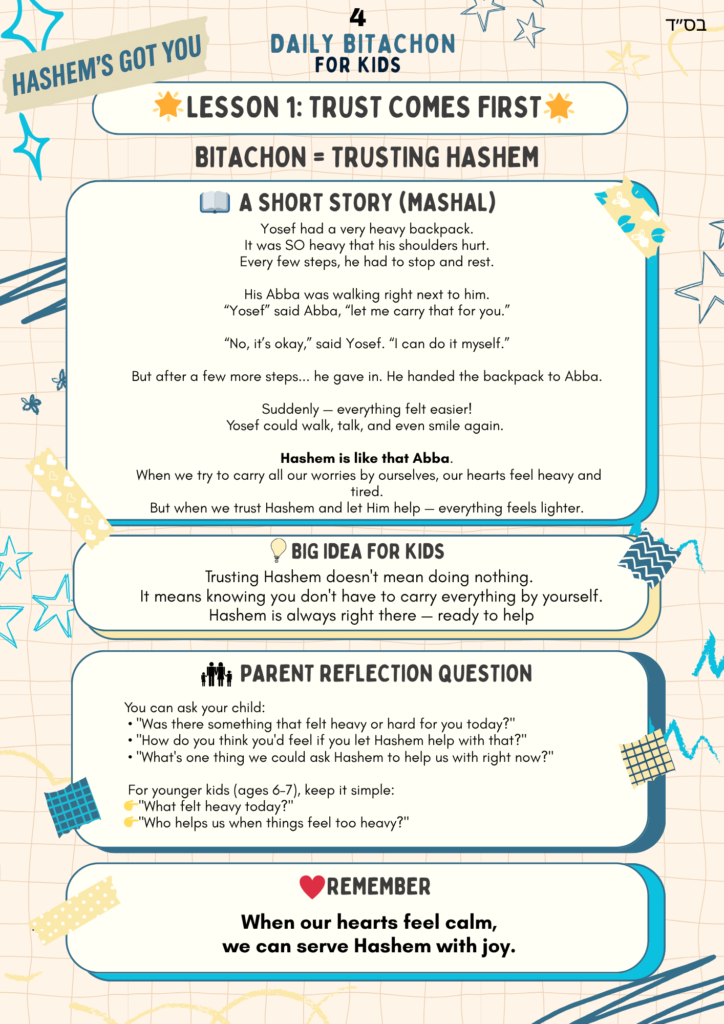
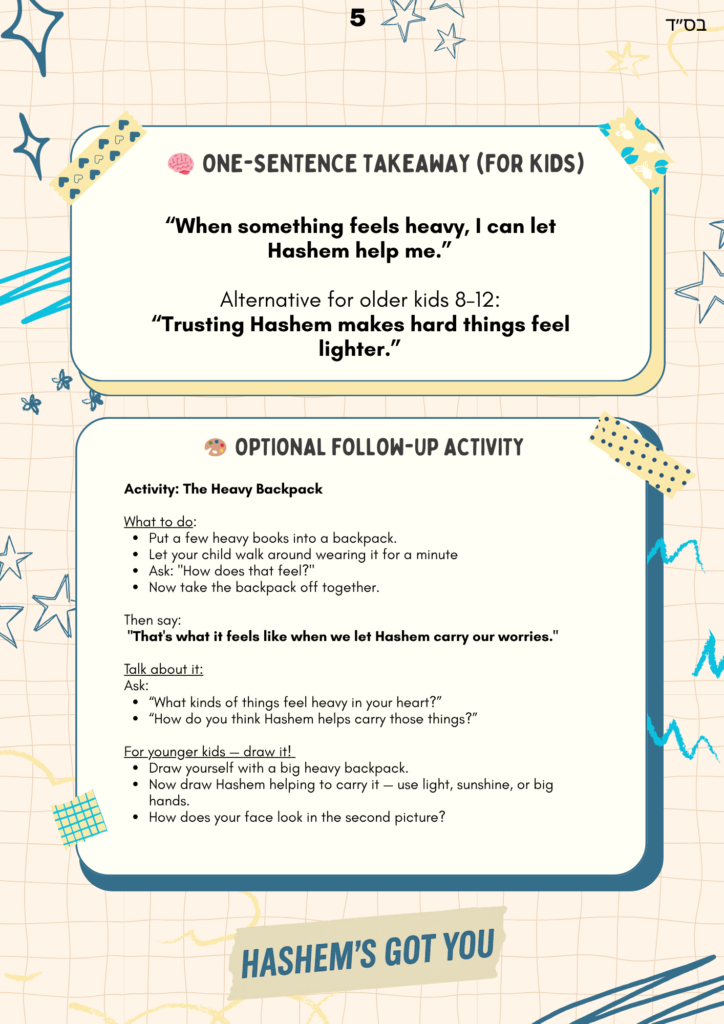
This is a daily parent-child program — short, joyful, practical — built to bring real conversations about Hashem and trust into every single day. Seven short activities a week, plus a Shabbos review. Flexible enough for real life. Built for consistency, not perfection.
It works at home. And it works in the classroom — the program is built so a teacher can run it as a daily opening activity, a weekly discussion, or a full unit. A few minutes a day is enough to start rewiring how a child sees Hashem’s role in their life.
Because this gap isn’t just a family problem. It’s a communal one.
Picture Your Child Tonight
Picture a child the night before a test.
Stomach tight. Can’t sleep. Running through everything that could go wrong.
Now picture that same child. Same test. Same pressure. But with something solid underneath them. Not certainty that they’ll ace it. Something deeper. A quiet knowing that Hashem is in this with them. That whatever happens, they are not alone in it.
That’s not a personality type. That’s not something some kids are born with. That is a skill. And it is built.
“We really enjoyed it!! I did it with kids ages 8 and 11, sometimes with a 5 year old. It led to good discussions and lots of questions. They enjoyed the stories, and I liked the questions and one line takeaways.”
— S. A.
“I love the entire PDF. I wouldn’t change anything.”
— M. R.
“This was a pleasantly different experience that made us closer.”
— G. R.
If this isn’t built early, life doesn’t get easier. It gets heavier.
Right now, most children don’t have it. Not because their parents don’t love them. Not because their teachers don’t care. Because nobody gave them the reps.
As they grow, the weight grows with them — shidduchim, parnassa, raising their own children. And if the muscle was never built, they carry all of it alone.
You can change that. For your child. Right now.
What Each Day Actually Contains
Here’s what each daily lesson includes:
- A short mashal
- A big idea for kids
- Reflection and discussion questions for parents
- A daily reminder that can be easily repeated
- One sentence takeaway for kids
- An optional follow-up activity to help drive it all home
This Is What I’m Asking You to Do
- If you have a child aged 6–11, start this with them this week. The first week is free. It takes a few minutes a day.
- If you teach, run it in your classroom this week.
- If you know a parent or educator, forward this to them right now.
Because the children who don’t learn bitachon today are the young adults at my table in Yerushalayim tomorrow, asking how to feel something when they daven. Those are the fortunate ones.
The window to build this is childhood. Don’t let it close.
→ Get Hashem’s Got You — Daily Bitachon for Kids
This is not a book. Not a shiur. It’s a daily system.
Hashem’s Got You,
Amir
P.S. The single most effective thing you can do after reading this: forward it to one parent or one educator who needs to see it. The child they’re raising needs this more than either of them realize.
You may also like:
 Bitachon Isn’t for Beginners: It’s the Maturity of the Soul
 The Most Exhausting Belief in Your Mind
 When You Do Everything Right… and Things Still Break
 The Real Reason Your Tefillah Feels Empty (And How to Fix It)
 Overcome Victim Mentality and Transform Your Life Through Bitachon
 From Exile to Redemption: Waking Up in a B’dieved World